in omnibus te ipsum praebe exemplum bonorum operum in doctrina integritatem gravitatem verbum sanum inreprehensibilem ut is qui ex adverso est vereatur nihil habens malum dicere de nobis (In all things shew thyself an example of good works, in doctrine, in integrity, in gravity, The sound word that can not be blamed: that he who is on the contrary part may be afraid, having no evil to say of us.)
Archives For November 30, 1999
For he saith to Moses, I will have mercy on whom I will have mercy, and I will have compassion on whom I will have compassion.
[Mosi enim dicit miserebor cuius misereor et misericordiam praestabo cuius miserebor.]
It would seem that Our Lord finds our desires not too strong, but too weak. We are half-hearted creatures, fooling about with drink and sex and ambition when infinite joy is offered us, like an ignorant child who wants to go on making mud pies in a slum because he cannot imagine what is meant by the offer of a holiday at the sea. We are far too easily pleased.
As you perhaps know, I haven’t always been a Christian. I didn’t go to religion to make me happy. I always knew a bottle of Port would do that. If you want a religion to make you feel really comfortable, I certainly don’t recommend Christianity.
Yet even now, says the Lord, return to me with all your heart, with fasting, with weeping, and with mourning; rend your hearts and not your clothing. Return to the Lord, your God, for he is gracious and merciful, slow to anger, and abounding in steadfast love, and relents from punishing.
Real forgiveness means looking steadily at the sin, the sin that is left over without any excuse, after all allowances have been made, and seeing it in all its horror, dirt, meanness, and malice, and nevertheless being wholly reconciled to the man who has done it. That, and only that, is forgiveness, and that we can always have from God if we ask for it.
And be not conformed to this world: but be ye transformed by the renewing of your mind, that ye may prove what is that good, and acceptable, and perfect, will of God.
Glória in excélsis Deo
et in terra pax homínibus bonae voluntátis.
Laudámus te,
benedícimus te,
adorámus te,
glorificámus te,
grátias ágimus tibi propter magnam glóriam tuam
Well then, I will tell you. Alexander, Caesar, Charlemagne and I myself have founded great empires; but upon what did these creations of our genius depend? Upon force. Jesus alone founded His empire upon love, and to this very day millions will die for Him. I think I understand something of human nature; and I tell you, all these were men, and I am a man: none else is like Him; Jesus Christ was more than a man. I have inspired multitudes with such an enthusiastic devotion that they would have died for me but to do this it was necessary that I should be visibly present with the electric influence of my looks, my words, of my voice. When I saw men and spoke to them, I lighted up the flame of self-devotion in their hearts. Christ alone has succeeded in so raising the mind of man toward the unseen, that it becomes insensible to the barriers of time and space. Across a chasm of eighteen hundred years, Jesus Christ makes a demand which is beyond all others difficult to satisfy; He asks for that which a philosopher may often seek in vain at the hands of his friends, or a father of his children, or a bride of her spouse, or a man of his brother. He asks for the human heart; He will have it entirely to Himself. He demands it unconditionally; and forthwith His demand is granted. Wonderful! In defiance of time and space, the soul of man, with all its powers and faculties, becomes an annexation to the empire of Christ. All who sincerely believe in Him, experience that remarkable, supernatural love toward Him. This phenomenon is unaccountable; it is altogether beyond the scope of man’s creative powers. Time, the great destroyer, is powerless to extinguish this sacred flame; time can neither exhaust its strength nor put a limit to its range. This is it, which strikes me most; I have often thought of it. This it is which proves to me quite convincingly the Divinity of Jesus Christ.
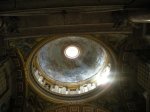
St. Peter’s Basilica, Basilica Sancti Petri, Basilica di San Pietro in Vaticano