


I recently had the pleasure of listening to a Roaming Millennial stream in which she and another libertarian conversed with two white ethno nationalists concerning the concepts of white nationalism and their desires for a white ethno state in the United States. This brought about several different feelings upon hearing these views articulated from confusion to laughter as I attempted to grasp this strange and intellectually bereft world view. I have since been doing some digging in this strange microcosm of the Alt-Right and feel compelled to set the record straight when it comes to these ideas by drawing the lines between nuance and blind ideological ignorance. I have decided to compile a short list of some talking points along with my own personal analysis as to why this particular world view ignores historical precedent and is delusional in its attempt to grasp a utopian image of certain cultures.
I feel it is pertinent to state that my genetic ancestry and upbringing don’t lead me to agree with the world views being espoused by white nationalists. Despite my DNA consisting of 52% white DNA, I am under no delusions that I am acceptable to such people particularly those who grew up in the United States. In fact on multiple occasions I have seen ethno nationalists declare that it is mixed people such as myself that are the bane of white existence as I am contributing to some mythical “genocide.” Furthermore I have done constant traveling both abroad and domestically which in turn sways my views from a broad more global perspective on origin and nationality. By no means am I a preacher of multiculturalism and diversity. However that being said I tend to weigh both the pros and cons of the different multicultural ideologies and policies. By doing so I believe I am able to view things in a more objective way that is not contingent upon it agreeing with my chosen world view or ideology.
Immigration
Firstly I disagree with the constant reference to all white people in monolithic terms in an effort to play the identity politics game. I do not understand the constant need to collectively group people who would otherwise be opposed historically in the efforts of gaining political power today. Mind you political power and political gains are the crux of the whole white ethno national movement. The ultimate core of the ideology is the hopes that by implementing political action that time can be suddenly reversed along with the present day sociological make up of our present nation states. Now of course to the average learned individual this would appear to be a foolish aim: it is. Not only is reversing such times not feasible but it is not desired by the majority of the populations in question. I often hear white ethno nationalists cite the 1960s as this utopian goal which needs to be achieved. They often lament the immigration of non-white persons that supposedly occurred after this period despite the historical facts showing overwhelming restrictions upon not only immigrants from Asian and Africa but also Eastern and Southern Europeans. They often characterize the immigration policy as changing to prefer non-white immigrants but that is simply not the case. Immigration in the United States simply evolved from an origin based system for selecting immigrants to a merit based one. A merit based system of immigration is infinitely more American in the constitutional sense than one based on national origin. So why is the influx of immigration from places besides Northern and Western Europe viewed in such a negative light and are there any compelling arguments for why this immigration needs to cease? From my listening to the arguments and further reading I have yet to find a convincing argument for doing away with current immigration practices. Immigrants especially today must be subjected to vetting and meritocratic formulations to be chosen for legal immigration into the United States. I have yet to see any compelling evidence that this population of non-white immigrants to the US are a net negative for American society.
Now lets hypothetically toy around with this ridiculous notion that ethno nationalists have in regards to immigration. Their proposal is for immigration especially for non-whites to simply cease to exist. Not only would this not be in line with American constitutional values but its simply not how America has done things even before the 1960s. Next step on their agenda is for non-white peoples to emigrate to their national countries of origin. For starters this would be a logistical nightmare in which authorities would need to DNA test every individual to determine their origin and level of whiteness. Additionally many immigrants and non-white persons in the United States no longer possess a country of origin to return to and would have no compelling reasons to leave their possessions and adopted homeland. This predicament is never addressed by white nationalists and ethno nationalists. So besides the logistical nightmare that is emigration what are they going to do about the historical implications? Are they going to go as far back as recorded history will allow or are they going to simply pick a time and essentially rewind human history until that time? Who are the deciders of said time and will it only be whites deciding which time period? These questions are not addressed.
Racial Hatred
I found it utterly ridiculous when I heard some white ethno nationalists attempt to classify the emotion of hate as not only a naturally occurring emotion, which granted it is, but rather its also a justifiable one. It is incredibly mind numbing to believe such brain twisting takes place where people take a negative emotion like hatred that is proven to be psychologically degenerative and destructive and attempt to paint it as justifiable manifestations of pride. I suppose their line of reasoning is that because our modern cosmopolitan societies involve different ethnicities living in close proximity to one another then this hatred to other ethnicities is not only inevitable but righteous hatred. Naturally this line of thinking is not only absurd but ignores the personal responsibility of the individual to choose to partake in our civilized society by observing the constitution. While I can understand being upset at certain policies and ideologies that can be viewed as threatening particularly left/progressive ideologies, I can not understand the intellectual leap that needs to take place from simply combating poor policy directives to moving on to such extreme and indefensible far right positions.
Often I see white ethno nationalists quoting DOJ crime statistics but naturally they only employ the use of statistics that support their narratives which are 1. that blacks are violent and 2. that violence would decrease if the ethnicities would not mix together. This of course is not only categorically false but dishonest in its analysis of statistical data. Yes the black community deals with a violence and crime issue but that is in large part due to the cultural implications in particular areas of the black community. This might blow a lot of ethno nationalists minds but not all blacks are the same culturally despite constantly being group into a monolith for political purposes. The blacks particularly in the south are the ones who are more violent than say ones from the northeast and in large part that is due to blacks adopting the predominant Scot-Irish culture post-civil war which is tribalistic and views violence as a solution to quarrels. This view can also be found in the Mongol and Arab cultures as well as the Scot-Irish and therefore is not unique to American blacks. But naturally I wouldn’t expect a ethno nationalist to grasp the nuance that needs to take place when distinguishing peoples cultures and of course they won’t acknowledge the negative aspects of the adopted Scot-Irish culture, a white culture.
Mixed Races
The ideas in regards to race mixing were rather archaic and arbitrary. They basically believe that all miscegenation laws would need to be put back into effect and that all mixed individuals would need to essentially pick a side. As a mixed individual I can say with complete confidence that these ethno nationalists and white nationalists are incapable of grasping the complexity that makes up an individual’s personal identity, especially if that individual is of mixed ethnic ancestry. They appear incapable of understanding how an individual would not feel torn internally simply because a certain ethnic group is unwilling to accept a mixed individual into their ethnic enclave. Whether a person is accepted or not is largely not up to that individual and therefore a mixed individual is largely at peace with their identity because how they are received is mainly not something that is controllable from the outside. I can’t control whether a person views me as white, asian, or black so why bother fretting over such trivialities?
Anyway these are my initial thoughts from delving into this bizarre subculture of nationalists. I imagine I will be writing more on the subject as I see fit and if I find points that need refuting. I can empathize with the feelings of ethno nationalists but the methods and desires which go in the face of reality are not something I can take seriously.

So I recently have been doing some reading about some of my ancestors, the Acadians, inspired by some recent historical findings via family trees and DNA testing. I figured by documenting some of the key aspects of my reading I would better retain the information as well so I intend to periodically record some of the key people, places, and events I come across. No real format will be employed for this series as this is primarily for personal use however I do hope others find the information useful if not intriguing.
Pre-Settlement Acadia:
- The province’s indigenous inhabitants, the Mi’kmaq, had lived there for centuries. They spent summers in coastal villages and winters in smaller groups, hunting protein-rich game (including seals, bears, moose, caribou, and beaver) across the uplands of what would become the Canadian Maritimes.
- The first accounts of the Mi’kmaq date to July 1534, when Jacques Cartier came across two “fleets” totaling “forty or fifty canoes” in Chaleur Bay off present-day New Brunswick.
- The Mi’kmaq learned to trade with the Europeans often trading food and furs for iron tools and weapons.
- The Mi’kmaq retained an overarching political structure called the Sante Mawi’omi or Grand Council.
- While the Mi’kmaq were eager to participate in the New World economy established by the Europeans they were not eager to partake in the political or religious aims.
First Settlements
- Frenchmen began arriving in numbers in 1604, three years before the foundation of Jamestown and sixteen before the Mayflower landed at Plymouth Rock.
- Pierre du Gua, sieur de Monts was granted the first charter by Henry IV of France in hopes of establishing relations with the Mi’kmaq, spread Christianity, and establish the area for the French crown from the British claims.
- Port Royal was mapped out and chosen as the spot where de Monts would establish the settlement.
- After surviving for 3 years de Monts saw his charter revoked by Henry IV. De Monts subsequently ventured west into Québec leaving Port Royal without an imperial ruler.
- New command of the settlement of Port Royal was taken up by Jean de Biencourt, sieur de Poutrincourt, and his son, Charles de Biencourt de Saint-Just.
- Poutrincourt had been one of de Monts’s partners on the 1604 voyage, and maintained a dogged determination to turn Port Royal into an agricultural colony.
- The Poutrincourt dynasty never realized its goal. Father and son fought with Jesuits and their powerful French patrons, struggled in vain to lure migrants to Port Royal, and suffered a devastating 1613 assault by English marauders from Jamestown.
- The elder Poutrincourt was killed while dealing with domestic anti-monarchical uprisings in his native France. The son died in 1624 back in Port Royal leaving the French Acadian settlement without leadership once more.
New Scotland
- The English attempted to claim the territory by granting a charter in 1621 to the Scot William Alexander. In 1629 Alexander’s son and 70 Scots arrived at Port Royal now abandoned by the French who had moved south to Port Loméron.
- The colony despite help from the French and Mi’kmaq barely survived the winter.
- New Scotland ceased to exist after the French fought the Scots defeating them in 1632 and sent them packing back to England.
- In 1632 the Treaty of Saint-Germain-en-Laye returned Acadia to France.
Acadian Civil War
- Charles de Menou d’Aulnay de Charnizay. D’Aulnay came to Acadia in 1632 as an agent of his cousin Isaac de Razilly, a naval officer.
- Razilly was placed in charge of Louis XIII interests involving trade and settlements under the French crown.
- Charles de Saint-Étienne de la Tour was granted similar powers by the crown.
- When Razilly suddenly died in 1635, d’Aulnay asserted himself as the sole ruler of Acadia.
- This power struggle between d’Aulnay and la Tour erupted into a full blown civil war lasting over a decade known as guerre civile acadienne.
- D’Aulnay successfully rebuffed an attack from la Tour and proceeded to blockade la Tour’s fort of St. John. La Tour escaped the blockade and was able to round up men from Boston to defend St. John and attack d’Aulnay at Port Royal once more. The attack was again rebuffed.
- While la Tour was away in April 1645 d’Aulnay sieged St. John once more ultimately defeating La Tour’s wife Françoise-Marie Jacquelin, who later died, and sending la Tours into exile in Québec.
- Final revenge though was to be la Tour’s who ended up marrying d’Aulnay’s widow, Jeanne Motin de Reux, after he perished in a boating accident in May 24, 1650.
- Due to d’Aulnay’s noble connections he was able to obtain more families interested in leaving war torn France behind for the new world. Such families include: Bourg, Gaudet, Leblanc, and Thibodeau.
Agriculture
- The success of the Port Royal and settlements along the Bay of Fundy had much to do with the process of land reclamation by controlling the sea levels.
- The areas where d’Aulnay and the new familes were from Poitou, Anjou, Saintonge, Aunis, and Brittany were known for their dikes and waterway controls in place to separate solid ground from the swamps back in France.
- This technology would become the source for Acadian granary riches and why their land became so desirable.
- Using sharp diking spades imported from western France, Acadians took to the marshes.
- Working on the rivières Missaguash, au Lac, Tantramar, Memramcook, and Petitcodiac, the first Beaubassin colonists drained hundreds of acres within a generation.
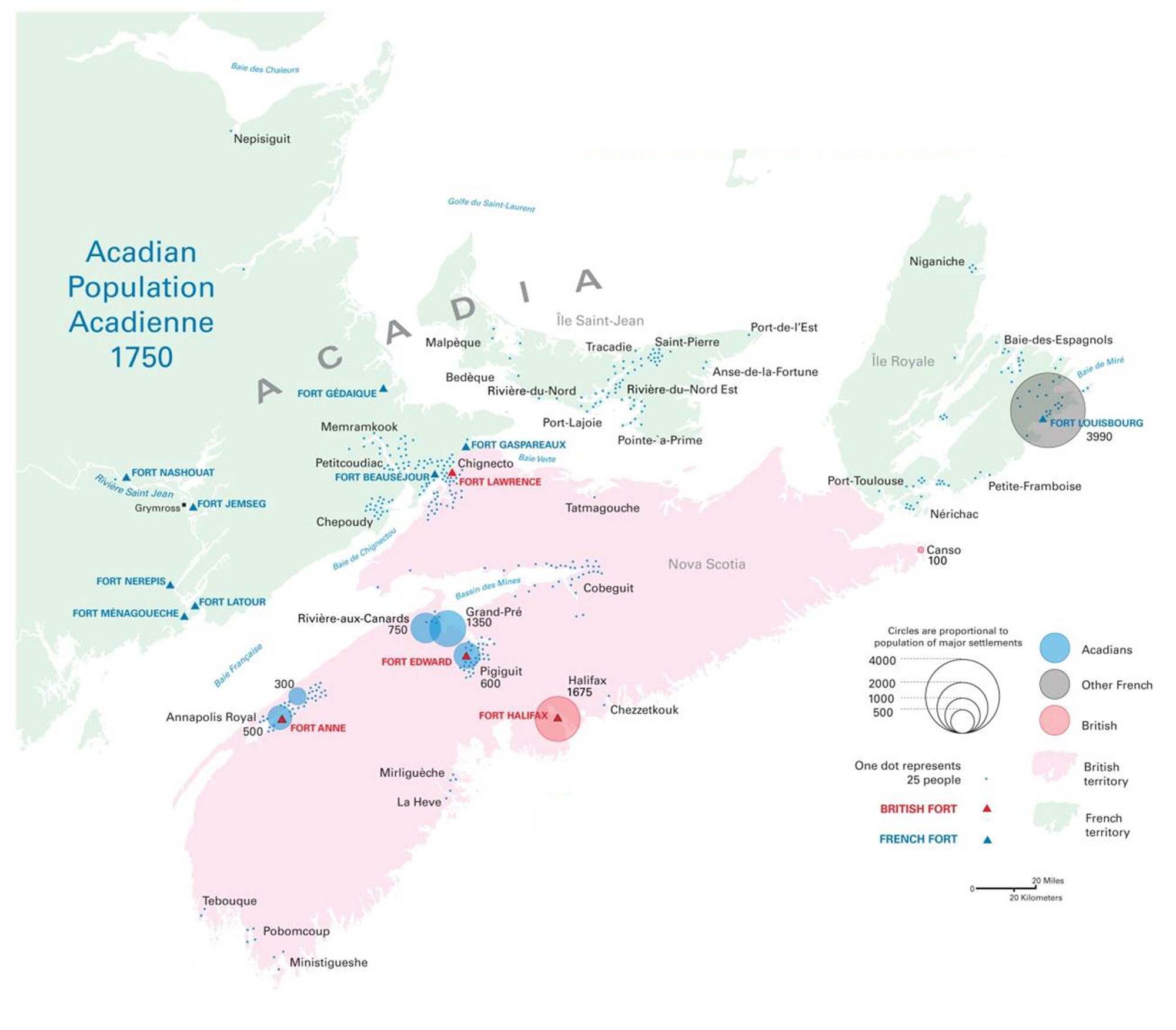
- Several Acadian families including Landrys, Thériots, and Melansons made their way to the Minas Basin in the 1680s about seventy miles northeast of Port Royal to establish the village of Grand Pré or Great Meadow.
Life in Acadia
- The population of Acadia grew to nearly fifteen hundred by the end of the seventeenth century. Minas (where my family lived) was then on the cusp of outstripping Port Royal, with nearly five hundred inhabitants.
- Acadians ate well, aged gracefully, and managed to integrate most French, Irish, English, and even Basque migrants into their little societies with admirable equanimity.
- Much of the profit from the meadows in Port Royal, Minas, and Beaubassin went toward imported provisions and manufactured goods, especially those on offer from New Englanders.
- The flow of goods and produce up and down the Bay of Fundy made new people as well as new fortunes. In the last quarter of the seventeenth century, a little cadre of Bostonians and Acadians laid the groundwork for a transnational, bilingual, cosmopolitan community that would bind the two colonies even as imperial tensions rose.
- Although very much a part of the French Empire, Acadia functioned as an off shoot of the Massachusetts economy.
Changes in Acadia
- At the close of the 17th century things began to change in the Acadian region both politically and imperially.
- Emboldened by the overt anti-Catholicism of William and Mary’s régime and provoked by French privateers authorities staged hit-and-run attacks on Chignecto and Minas.
- In 1710 Samuel Vetch took possession of Port Royal in October, renaming the little settlement Annapolis Royal in honor of the British queen.
- Nearly three years later, the Treaty of Utrecht ended the War of the Spanish Succession, and confirmed Great Britain’s right to what ministers called “all Nova Scotia or l’Acadie, comprehended within its antient boundaries.”
- This power change didn’t represent any real change because militarily the colonies possessed no real threat and the Mi’kmaq did not bother with French vs British affairs.
- The Acadians had simply invested too much in their lands on the Bay of Fundy to abandon them. The British in turn valued Acadian subjects as buffers against the still-powerful Mi’kmaq. It was an unsatisfying stalemate, but one that promised a measure of stability.
- The British through subtle means enacted policies which were to make Acadians dependent on British institutions while narrowing their economic options to exclude everything but the orderly cultivation and transport of grain along the Bay of Fundy.
- France decided to put its full attention on its other territorial claims of Ile Royale and Ile Saint-Jean. The fort of Louisbourg was built starting in 1719 and the French hoped the Acadians would consider relocating from their lands along the Bay.
- But with the Acadian’s status being neutral after 1740, the Acadians had few compelling reasons to pack up.
- The War of the Austrian Succession (King George’s War in the British colonies) was the ultimate trigger than precipitated the tensions in the Nova Scotia area.
Useful French:
- Grand Dérangement- The expulsion of 15,000 Acadians from the coastal areas around the Bay of Fundy at the hands of the British starting in 1755
- Rivière – River
- Guerre Civile Acadienne- Acadian Civil War
- Esseau- a plank that allows for freshwater drainage but snaps shut when the salty tide rises
- Gazons- harvesting blocks in rectangular shapes
- Aboiteaux – smooth-faced dike walls up to ten feet high, then packed the structure’s center with brush, clay, and more “odd” sods
 Acerbity [əˈsɜːbɪtɪ]